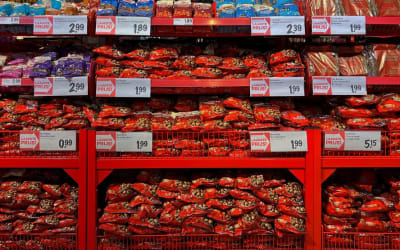
If you walk down any UK supermarket aisle, front-of-pack traffic light labels are often the first detail a shopper notices.* Green signals a healthier choice, amber calls for moderation, and red warns of high levels of fat, saturated fat, total sugars, or salt per 100 grams. For food manufacturers and brand founders, shifting a red or amber rating to green is not merely a public health goal. It directly impacts consumer purchasing decisions, retailer positioning, and brand reputation in an increasingly health-conscious market.
In my consultancy work alongside my practice, I regularly help food businesses review product formulations to optimise their nutritional profiles. Improving a front-of-pack traffic light colour rating requires a delicate balance. You must reduce targeted nutrients without compromising texture, shelf-life, or the characteristic flavour profile that your customers love. If you want to dive deeper into broader regulatory frameworks, my food labelling regulations guide outlines the wider legal context in the UK.
Understanding the UK Traffic Light Thresholds
To systematically improve your ratings, you must first understand the precise thresholds set by the UK Department of Health and Social Care. Traffic light indicators measure four key nutrients per 100g or 100ml for foods and drinks. For solid foods, a green rating for total sugar requires 5g or less per 100g, while more than 22.5g triggers a red label. Similarly, salt receives a green label at 0.3g or less per 100g, whereas anything exceeding 1.5g per 100g receives a red label.
Saturated fat thresholds are equally strict, requiring 1.5g or less per 100g for green and over 5g for red. When I conduct nutritional audits for food brands, we map out every ingredient to identify which specific component pushes the product over these legal thresholds. Often, a product sits just above an amber threshold where a minor formulation tweak yields a green rating without noticeably altering taste.
Smart Reformulation Strategies for Sugar and Salt
Reducing sugar and salt is frequently the most challenging part of reformulation because both ingredients perform structural and preservation functions alongside providing taste. Simply removing sugar can compromise mouthfeel, bulk, and shelf stability. In my business advisory work, I recommend using functional swaps that retain volume while lowering overall simple sugar content.
Here are practical strategies I often employ during product reformulation consulting:
- Gradual reduction: Step down salt or sugar concentrations by 5 to 10 percent per batch iteration to allow taste panels to adapt without noticing sudden flavour changes.
- Enhancing natural aromatics: Utilise herbs, spices, citrus zest, or umami-rich natural ingredients like yeast extract to offset sodium reductions.
- Incorporating soluble fibre: Replace bulking sugar with chicory root fibre or oats, which improves texture while adding beneficial dietary fibre.
- Fruit puree integration: Use whole fruit pastes or unsweetened purées to provide natural sweetness alongside micronutrients and fibre, replacing refined sugars.
- Portion density adjustment: Re-evaluate moisture content and serving matrices to favourably adjust values per 100 grams.
Optimising Fat and Saturated Fat Profiles
Saturated fat is another primary driver of red traffic lights in bakery, dairy, and ready-meal categories. Replacing tropical oils high in saturated fat, such as palm oil or coconut fat, with unsaturated plant oils like rapeseed, high-oleic sunflower, or olive oil significantly reduces saturated fat content per 100 grams. This simple shift often transforms a red saturated fat rating into an amber or green rating.
In addition to raw fat content, emulsification techniques can help maintain creamy textures using lower fat inputs. In my work helping brands align with broader health metrics, detailed in my guide on nutrition strategy for food businesses, we focus on maintaining organoleptic quality so consumer loyalty remains intact while health metrics improve substantially.
Aligning Traffic Light Labelling with HFSS Compliance
Improving front-of-pack traffic light ratings often goes hand-in-hand with improving your product's Nutrient Profiling Model score for HFSS (High in Fat, Sugar, or Salt) regulations.* Products with fewer red traffic lights are far less likely to be restricted under UK promotional and placement rules. You can read more about these requirements in my overview of HFSS regulations.
By taking a holistic approach to reformulation, food businesses can achieve green or amber traffic light ratings while simultaneously securing clearance for prominent supermarket placement and online advertising. Whether you are launching a new product line or updating an existing range, aligning your nutritional profile early saves significant time and expenditure during production scaling.
Navigating the technical details of traffic light thresholds and ingredient reformulation can feel overwhelming when balancing commercial viability and taste. If you are a food business or retailer looking to improve your product's front-of-pack colour ratings or ensure regulatory compliance, I offer specialised commercial consulting. Learn more about my professional services on my services page or reach out directly through my contact page to book an online consultation for your business today.